West with the Night: Toward Livelier Writing through Imagery and Symbolism (Week 1)
“There are many Africas. There are as many Africas as there are books about Africa…. Whoever writes a new one can afford a certain complacency in the knowledge that his is a new picture agreeing with no one else’s….”
–Beryl Markham, West with the Night
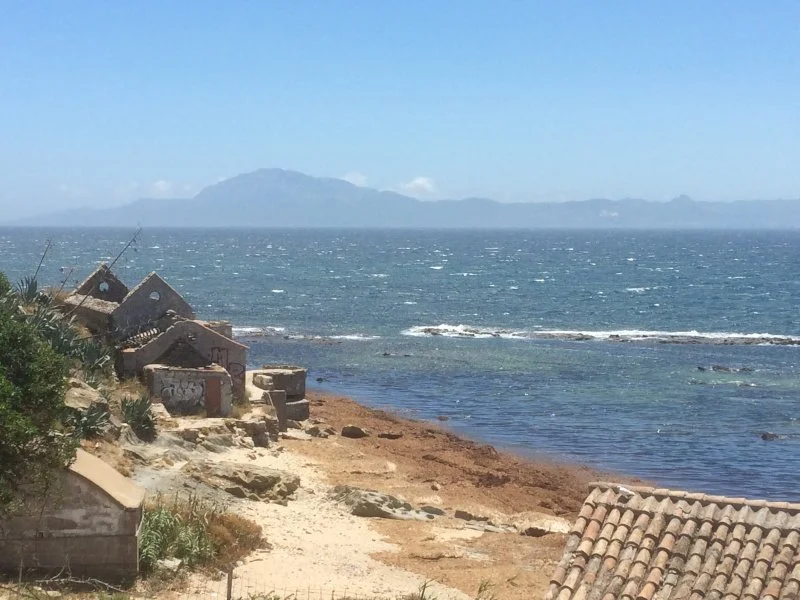
Not an image of Kenya (apologies, I have none). This is Morocco, viewed from Tarifa, Spain…the closest I have come to Africa. Photo credit: Adam Groves / Ultreya Editorial
I was fascinated to learn, as I began to write about Beryl Markham’s brilliant memoir with the aim of helping writers elevate their craft, that West with the Night, which was published to great acclaim, fell into obscurity not long after. The book was only rediscovered decades later, when it enjoyed a resurgence in popularity.
Life imitates art, as a book full of rich and lively stories and feelings becomes the protagonist of its own.
Over the next few weeks we will dive into the topic of imagery and symbolism in storytelling, referring to Markham’s book for examples. We will:
See how these creative tools help bring your stories to life (and avoid the snare of flat storytelling that may bore or alienate you and your readers).
Learn how these tools help to cultivate an engaging dialogue between you, your story, and your readers (as opposed to a listless monologue).
Come to appreciate how the lush world of words and meaning evoked by imagery and symbolism inspire wonder and return visits to your story world.
But first, let’s bask in the intriguing quirk of fate which befell Markham’s book.
West with the Night was adored by the first flocks of visitors who landed in its countryside in the 1940s (Ernest Hemingway said, “Written so … marvelously well, that I was completely ashamed of myself as a writer”). After falling out of public consciousness for a long time, Markham’s book was embraced by a whole new generation, who descended upon the (approximate) fortieth anniversary celebration of its literary founding. And I loved it last month, yet another forty years later, when I, too, strode with Beryl through Africa.
I stalked wide-eyed alongside her as an eager, open-hearted girl, accompanying her Murani friends, with her scarred and steadfast dog Buller at her side, on a warthog hunt through tall grass that would one day be part of Kenya. I chewed the nib of a pen with her as a lonely young horse trainer, worrying over business ledgers in weak light and waiting unknowingly for a pair of mundane, life-changing interruptions. I winced with her as a confident and maybe foolish adult as we crawled over the roots of tightly-woven trees and through dirt squirming with biting insects in order to escape from an elephant who had turned the tables on a scouting mission.
I loved reading this book, as many others did and do. But in the vein of Markham’s musings about the landscape of her life, what book was each of us loving? What Beryl? What Africa? Across time and space, as we compare postcards and pictures from our travels to her world, do we find that they come from the same place or concern the same events? In some ways, yes; in other ways, maybe not at all. But more important than any of these questions is why. Why do so many people love West with the Night?
Any lover of patterns, or of the strange and wonderful symbiotic environment braided from art and life, can relish the fractal symmetry which the story about the book West with the Night shares with the tales between its covers. For here we have a collection which revolves around the mutability of Markham’s vivid, fleeting coming-of-age experiences in the fertile, ever-shifting, ever-freshly-discovered rivers and jungles and valleys and deserts of Africa. And alongside that we have the knowledge that the memoir itself possesses—and lived out—the same mystery and plasticity.
And it is entertaining to wonder whether the book’s horse trainer/aviator/author foresaw that Africa would transform geopolitically not long after her book was published. It is also fun to ponder whether she knew, somehow, that her book would drift out of public consciousness and therefore wrote circumspectly to future-proof her words.
But it is not necessary to ascribe godlike vision to Markham in order to admire, learn from, and emulate the depth and complexity of images and symbols which burst forth when one reads her writing and which, in my opinion, are one big reason for the book’s enduring appeal.
As the quote at the beginning of this essay shows, Markham wrote from a very simple awareness: that her subject matter was enormous, elusive, and absurd to try to capture … but worth the humble effort. This is a basic observation that every writer is capable of making about any subject matter. (In point of fact, I suspect Markham had life in mind as well when she talked about Africa’s elusiveness.) And the tools she used to communicate her reverence for the complexity of her subject matter are tools that any of us can learn to wield skillfully in order to create stories of our own that are as full of life and mystery and meaning as hers.
This month we’ll dive deeper into the how, but we are already learning from the what; that is, from the book itself.
Isn’t it wonderful that Beryl Markham’s memoir is more than a mere assortment of facts (like physical dimensions, genre classification, ISBN, and Cliff Notes summary)? Doesn’t it make the book that much more interesting, that much more tempting to read, once you discover that the memoir is a creature in its own right, a protagonist with lively innards and stories of its own to tell in addition to the history painted upon its rippling hide? Once you learn that it grunts and gleams and dives and radiates noise and heat, just like you do as you soar in and out of the clouds scouting for a glimpse of that book far below … doesn’t it make your own hunt that much more enticing? Doesn’t the book just beg you to descend into its wilderness and scour its countryside to find it, to learn about it, to live with and in it?
In this digression that was really an introduction in disguise, I have taken pains to write about Markham’s memoir in a way that echoes her own use of imagery and symbolism.
Tastes and tactics vary, but I am confident that anything you write in such an imagistic spirit will be more engaging to readers than simply droning, for instance, “Beryl Markham wrote West with the Wind. It was published in 1942. It was famous, then forgotten, then famous again when it was rereleased in 1983. She tells stories about her life in British East Africa. In some she is a child on her dad’s horse training ranch. In some she is a horse trainer herself. In some she is an accomplished aviator who makes deliveries, scouts for big game, and pilots a historic trans-Atlantic flight.”
Can you see the lush contrast between using tools like imagery and symbolism and merely reporting facts?
Some writers will already be familiar with the literary devices which we will discuss this month. Others, not as much. Wherever you are in your writing journey, I believe you can gain something from this conversation. However, I have tailored it especially to aspiring first-time writers of memoir and creative non-fiction.
For every reader, though, know (or remember) this right off the bat:
Imagery and symbolism are writing tools that can be particularly valuable when you tell true stories, because they help you to craft a fuller, livelier picture of your truth and to plunge more urgently and dynamically into the stories of your life. (And the same will also be more likely for your readers.)
Unfortunately, something I see frequently in memoirs that I edit is an impulse to report events plainly and directly, and to declare the meaning of those events just as explicitly. This can hamper your connection with your story and the experience of writing it, and it can negatively impact how others read it.
I think writers of non-fiction come by this instinct to literal storytelling and transparent interpretation honestly, and I respect the integrity that it implies. You are dealing with the truth, after all. You can’t make the jerk who got you fired eight feet tall just because it would be nice to invoke a David-and-Goliath theme. Right? You can’t move the story from a rest stop along Highway 70 onto a trail in the Dolomites to give the reader the sense of breathless exhilaration you felt when the love of your life proposed. Right? There’s no way for readers to understand what you mean unless you announce it. Right?
And there’s really no space for creativity, because this is real life; there’s no spaceship or dragon or ghost. It can’t help but be boring.
Right?
It makes sense if you feel constrained by the facts. We can’t twist the truth, can we? Well, no and yes. The simplest way I can explain that is to say that the truth is usually much more than we assume it to be, so long as we let it be.
Imagery and symbolism are just a couple of the powerful ways you can dig deeper into the truth than the mere surface seems to allow. They help enliven even the most seemingly boring circumstances, for writer and reader alike.
To set a foundation for the next month of discussion, let’s establish a few things. First, what are we talking about when we say “imagery” and “symbolism”?
An image is a lively written representation of any given thing. That could be a person, an object, a place, a time of day, the state of the weather; basically any element of life that can be described in a sensory way and which ideally is described in a sensory way. That is to say, the word “toothbrush” is already an image in the most basic sense, but “a bent-bristled toothbrush frothing like a mint-chomping dog” is a very specific toothbrush that is better-equipped to take up robust imaginative space in a story.
Imagery and symbolism are related terms. Images attract associations and deeper meanings. You already know tons of symbolic associations even if you didn’t have the terminology for it. For instance, think of all the connotations that light or dark contains; or a lighthouse on a rocky shore in a storm, or a shadowy alley between two tall buildings that you must pass through late at night to catch the last train out of downtown.
Second, as always, the thoughts I’ll be sharing are not meant as absolute creative truth. There are times and places for being literal in any story. There are many paths to a lush, engaging story. And there is always room to succeed by breaking “rules.” Just take what I say as food for thought from someone who’s widely-read and has a good sense of literary mechanics.
Over the coming weeks, we will look at three examples from West with the Wind. We will see how Markham’s stories become much richer, not just in content but in feeling, meaning, and livability, by her use of imagery and symbolism. We’ll identify three key benefits of employing these writing tools, and we’ll also observe three contrasting risks of ignoring them. Finally, I’ll share some exercises to help you get your creative juices flowing.
Here’s a simple food-for-thought exercise to start with. As we dive into our exploration of imagery and symbolism this month, these will be helpful questions to keep in mind:
- How well do I really comprehend what happened in my life and what it means?
- What hidden potential might lie in the contents of my life if I looked with fresh eyes?
- What details do I tend to omit or gloss over?
- When I write, how can I help myself to live my story, instead of turning my experiences into a listless assortment of summaries and statistics?
See you next time!