Review of Joan Didion’s The Year of Magical Thinking
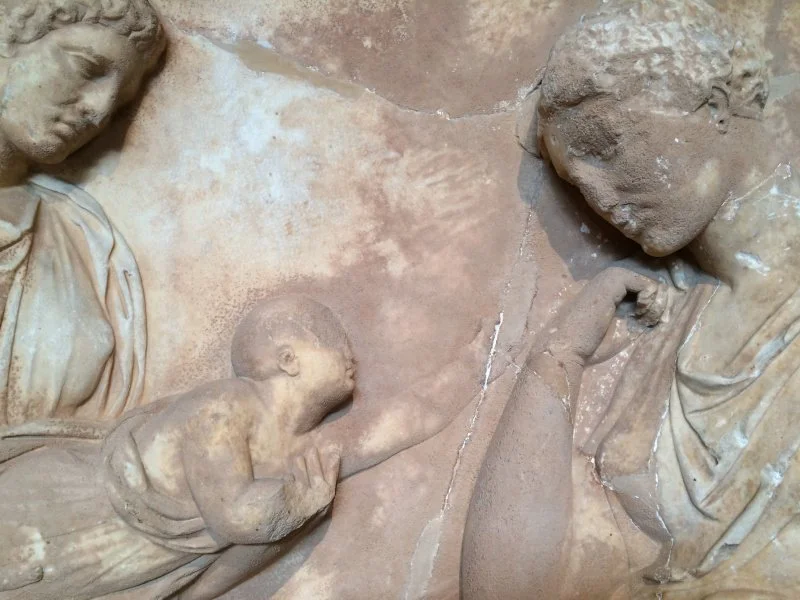
Detail from a funerary stele in the National Archaeological Museum of Athens. The mother (right) is the deceased. Her baby is pictured reaching eternally for the loved one who is gone forever. Photo credit: Adam Groves / Ultreya Editorial
“Life changes in the instant. / You sit down to dinner and life as you know it ends.” (p. 1)
“I had done [everything there was to do] …. And it still didn’t bring him back.” (pp. 42, 43)
“I am dropping my keys on the table inside the door before I fully remember. There is no one to hear this news, nowhere to go with the unmade plan, the uncompleted thought. There is no one to agree, disagree, talk back. ‘I think I am beginning to understand why grief feels like suspense,’ C.S. Lewis wrote after the death of his wife …. We are repeatedly left, in other words, with no further focus than ourselves.” (pp. 194, 95)
“Why do you always have to be right, I remember John saying.” (p. 138)
“Why do you always have to have the last word.” (p. 141)
“I had not sufficiently appreciated it.” (p. 155)
“Had I understood nothing?” (p. 173)
“For once in your life just let it go.” (p. 141)
“You had to go with the change. He told me that.” (p. 227)
Intense, disjointed, vulnerable, humble, brief, lingering.
Ms. Didion’s memoir leads readers lurching through the fragmented year of occurrences and avoidances and fixations and reflections and dazes and clarifications and denials and agonized acceptances which followed the sudden death of her husband less than a week after Christmas in 2003, along with the seemingly imminent death of her only daughter at the same time (and through the months which followed).
In a chronicle which is intimate and powerfully humane, Didion presents her naked, distraught spirit to all. She does not shy from displaying to readers her disoriented efforts to paw through the shattered remnants of a life which, for her, all at once, rudely and catastrophically has become less than half a life. She struggles valiantly to shore up the shape and meaning of her existence, even as she recognizes with discomfort her pathetic impulse to organize, to control, to determine outcomes through sheer magisterial willpower. To conjure the outcomes she desires. To bring back what is impossible for her to bring back.
And she battles, half-unconsciously, to surrender this will; to accept what has happened and that she is diminished in ways that can never be restored. She struggles to let go of her former wholeness, to let grief and woundedness in, and to float on.
Will Didion replace what was before this year of loss with something still true, if humbler; and still hopeful, if chastened? The narrative urges itself and the reader onward, and while its conclusion is not comforting in any typical sense, it provides a brutal sort of hope and beauty, the type which can only be encountered in as complete a reckoning with the truth as is possible for a human being.
Stylistically, Didion’s account of how her private narrative of comfort and stability was dismantled, by life and her own fumbling efforts, is instructive for aspiring writers of memoir in numerous respects.
#1: The book is keenly focused beneath its superficial disarray.
It does not try to be about everything in Didion’s life. Instead, plotwise and thematically, the memoir is narrow and disciplined. Is it full of anecdotes and digressions and medical fixations and literary allusions? Yes, but all of these are approached according to the same diagnostic protocol, and all lie down for surgery under the same set of scalpels.
The memoir delivers sustained attention to a small set of questions: How do I, Joan Didion, deal with death? Who actually am I? What does my life mean in the face of this death? Is there such a thing as mourning and moving on? Recurring motifs like “life changes in the instant” and “had I understood nothing?” help remind the reader of these questions, and they stitch the disparate parts together even as the sharp, not-quite-answerable edge of her questions dissects the illusion of comfort and competency that used to compose Didion’s perspective.
In this way, both Didion and the reader are always reminded what the journey is and may therefore hope together to arrive at its destination.
#2: Didion strategically uses and abuses sentence construction and plot progression (and digression).
In this book’s case, the effect is to simulate a state of shock. Reading this book often feels in a way like having just climbed out of a crashed car, or standing before a house that is burning down from which you have just escaped, or, of course, like being in the room with a loved one who just died.
As one reads, there is a sort of ringing in the ears which suggests the dizzying sound of emptiness that must have filled the author’s head after half of her existence fell on its face and did not get back up. The wandering of the plot and of her train of thought mirror a victim wandering in circles at the scene of a disaster and behaving in a nonsensical, compulsive manner. Racing or repetitive thoughts echo the frantic scraping and gasping of a mind attempting to clamber up out of its own caving-in pit of trauma and grief.
Didion demonstrates to writers how the style we use can amplify the story we are telling, the message we are sending.
#3: The book is brutally circumspect.
In this way it indirectly reminds other writers it is wise not to fly too close to the sun. Didion is, by all accounts, a titanic writer, one who could get away with all sorts of assertions, bald or otherwise. And the subject matter would have given her extra cover, for who wants to contradict someone in the throes of grief?
But Didion does not try to pretend she has even one answer, much less all of them; nor does she exploit her circumstances and the sympathy they would easily garner to hop on a soapbox and thrust hard-won wisdom upon the world. Instead, she voluntarily comes down from the dais. She confesses that she once thought she knew a lot, and she submits to the inscrutable lessons these events continue to teach her.
In short, the third lesson which this book reminded me of and which I pass along to aspiring memoirists (and writers and readers of all stripes) is this:
Be careful about what you think you know, and forthcoming about what you do not.
When the stuff of existence meets the urge to write about it, try putting the impulse to deliver conclusions at a distance. Instead, receive the writing space as your invitation to ask, explore, and learn more about life, others, and yourself…and to accept and love it all, and yourself in your not-quite-perfectly-put-together state.
None of this is to say that there is no time and place for bold declarations. It is only to point out that rich, profound communication and connection can be achieved in its absence … perhaps because of the absence of certainty.
Let’s close by leaning a bit closer to that final idea. As you write, see how it feels to simply ask, seek, learn, and love … and see how it feels to set aside the desire to already know for another day.
Ultreya, dear readers and writers! Ever onward and upward.